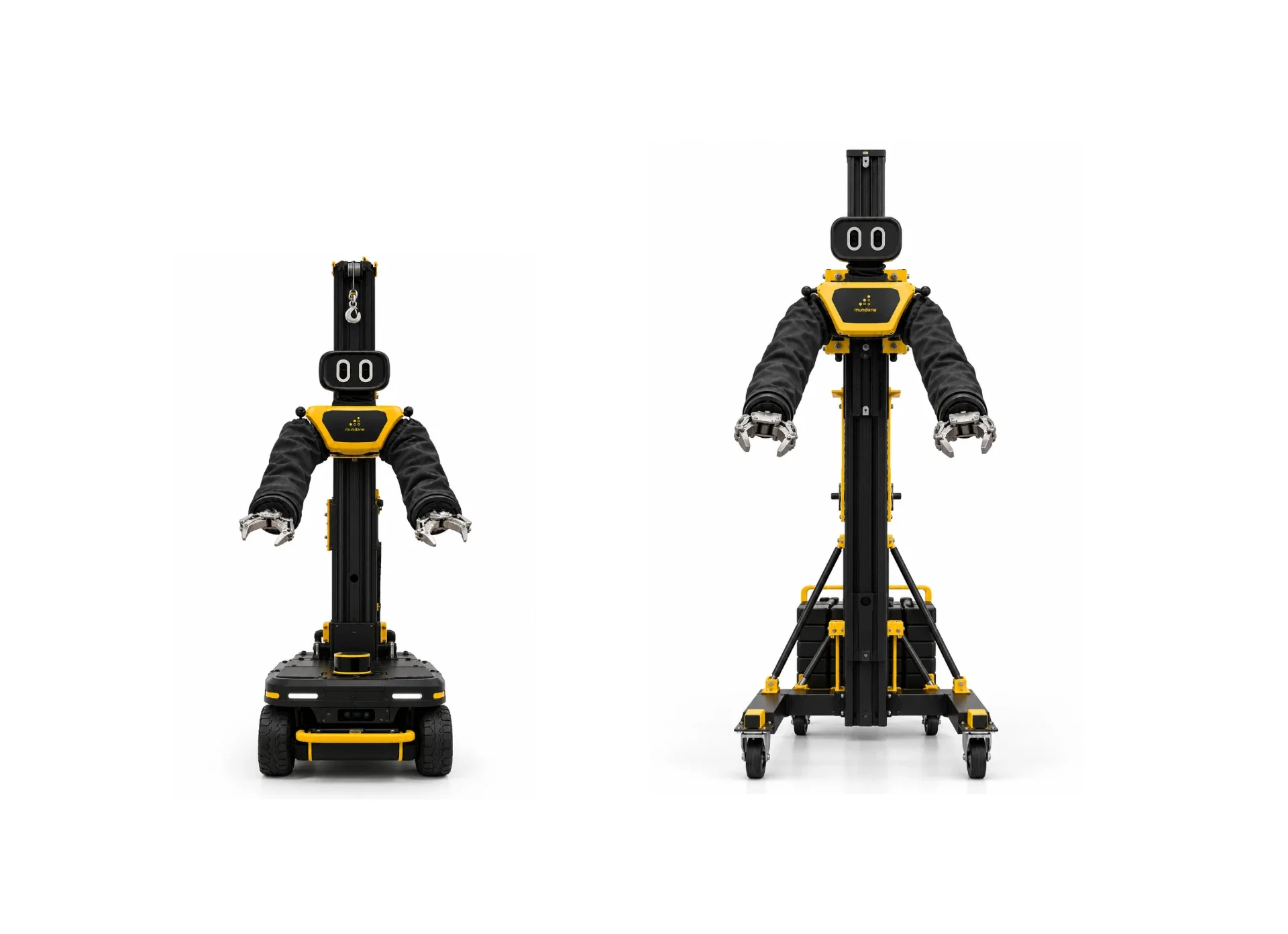
Robotics has repeatedly tried to begin where the field would prefer to end: full autonomy. That framing is understandable and, in some domains, correct. But it is hardest precisely in the industrial work where demand is highest: contact-rich manipulation, safety-critical procedures, variable environments, and tool-mediated tasks that resist clean specification. Self-driving is the cautionary case. A decade of capital and talent met a real world that offered no ctrl-Z; even the best-funded programs found that the last increments of reliability were disproportionately expensive and that tolerance for black-box failure was thin. Physical labor is, if anything, harder to standardize than driving.
So the near-term question should not be "how do we remove the human?" but "how do we build a tool that has economic value today while making a skilled worker measurably better at their job?" That reframing matters technically and politically. The dominant alternative for gathering physical data, egocentric capture, where workers wear cameras and instrumented gloves so a model can learn over their shoulder, is invasive, surveillant, and frankly dehumanizing. It asks people to instrument themselves for their own eventual replacement. We think there is a better path: give the worker a more capable body, not a body-cam.
1The physical data gap
Language and image models scaled quickly because the corpus already existed. The internet externalized human knowledge into text and pixels, including Wikipedia, code, photographs, and video, so pre-training had something vast and diverse to consume. Physical skill was never written down the same way. It lives in force, contact, timing, recovery from error, proprioception, tool use, and the tacit judgment of experienced trades workers, none of it well represented on the open web.
It would be wrong to say the data does not exist at all. There are robot manipulation datasets, tactile and force datasets, teleoperation corpora, rich simulation assets, and large video priors, and they have driven real progress. The honest problem is narrower and more stubborn: this data remains fragmented across incompatible hardware, sparse in force, tactile, and proprioceptive channels, concentrated in laboratory settings, thin on recoveries and near-failures, and poorly matched to the messy diversity of industrial work. A policy can only learn what the demonstrations contain, and most contain clean vision and little else. The gap is not the absence of data but the absence of force-rich, recovery-aware, industrially diverse data collected in a way workers will actually accept.
2Amplification is a better business than replacement
This is the mundane philosophy. Skilled workers remain the source of judgment, dexterity, intent, and domain knowledge; what changes is where they stand and what risks they absorb. A robot can take the heat, voltage, radiation, chemical exposure, height, confined space, and contamination risk; the human supplies improvisation, interpretation of ambiguous feedback, and understanding of what the task is for. This division of labor is both the more credible engineering path, since it does not require solving open-world autonomy before delivering value, and the more acceptable labor strategy.
That second point is not incidental. A program that quietly aims to make workers redundant will, rightly, be resisted; unions and skilled tradesmen have every reason to reject it, and the history of automation gives them cause. A program that moves a worker out of an arc-flash zone while keeping them employed, better paid, and able to apply their skill across more sites is one that workers, employers, and regulators can adopt together. We would rather build a genuinely good product and improve the working world in the process.
In this model the human is not a liability to eliminate; the human is the source of frontier intelligence. Software-based AI offers the precedent: it did not build companies on its own, it helped talented people build them faster, and the same will hold true in robotics. The aim is an amplified world, not a human-replaced one. Labor will change, but it should change in dialogue with workers rather than by pulling the rug from beneath them.
This is where an apparent contradiction has to be faced directly: if the tool lowers the cost of skilled hands-on work, how can the people who do that work earn more? The answer is that the cost of a task and the total work to be done are not fixed against each other. When a capability becomes cheaper and easier to reach, demand for it usually expands by more than its price falls, the pattern economists call Jevons paradox, first observed in the nineteenth century when more efficient steam engines burned more coal, not less, because efficiency made coal worth using in far more places. A great deal of skilled physical work is simply not done today because it is too dangerous, too remote, or too expensive to justify: deferred maintenance, skipped inspections, repairs that wait for a specialist to travel in. Lower the cost and much of that latent work becomes worth doing. Computing is the clearest illustration. A computer once filled a room and cost a fortune; as the price of computation collapsed, computers did not disappear but multiplied into everything, down to the chip in a smart bulb, and the industry, and the number of people who made a good living from it, grew by orders of magnitude. We expect skilled physical work to follow a similar arc: cheaper per task, far more of it done, and the people who can direct it more valuable rather than less.
Mundane has three phases, each one economically valuable by its own right:
- Local teleoperation (safety). The worker keeps full control and judgment, just no longer standing in the danger zone.
- Remote teleoperation (flexibility). The worker covers more jobs a day, no longer tied to one location or losing hours to commuting.
- AI-assisted operation (productivity). The worker directs several robots at once, using AI models for the mundane and repetitive tasks.
The safety case rests on a simple asymmetry: a broken robot costs significantly less than an injured worker. Damage and wear are part of the picture, not a failure of it. Because the machines are built from standardized, interchangeable parts, a damaged unit is fixed with a cheap swap rather than a custom rebuild, the way the auto industry turned a complex product into routine, low-cost service. A robot is a capital expense that can be replaced from a shelf; an injured person is irreversible, and brings downtime and liability on top of the human cost. Putting the machine, not the person, in the path of the hazard is what makes that trade worth making.
Every one of these phases, and the safety case most of all, rests on a premise we have so far taken for granted: that the worker can actually do the job through the robot. Whether they can is not a question of robotics in general but of the interface in particular.
3Today's interfaces are the bottleneck
Interfaces have repeatedly changed how we interact with technology. The mouse and the graphical desktop turned the computer from a specialist instrument into an everyday tool; the multitouch screen put one in nearly every pocket. Each time, a better way in expanded what the technology was good for and who could wield it. Our wager is that the next such shift is physical: a high-fidelity haptic exoskeleton that lets a worker feel and act through a remote body. But the analogy ends in one important place. Those earlier interfaces were more convenient doors onto capabilities that already existed; here the capability, a model of physical skill, does not yet exist, and the interface is precisely what brings it into being. The exoskeleton is what makes the work valuable today and what generates the contact-rich data any later autonomy will require. Getting the interface right is therefore not a finishing touch; it is the whole undertaking.
Teleoperation quality is not merely the ability to move a robot. The operator must build an internal model of the remote body and inhabit it. Proprioception, force feedback, low and predictable visual latency, sensible control mapping, motion scaling, and tool alignment all determine whether the system feels like an extension of the body or a remote tool fought through a screen. When presence is poor, operators compensate with caution and cognitive load, and both task performance and demonstration quality suffer.
This is why Mundane treats presence as a first-class engineering discipline, not a comfort feature. Crucially, the interface cannot be solved in hardware or software alone; it has to be both at once. The hardware, a haptic exoskeleton and end-effectors that deliver real force back to the operator's body, is what makes presence physical, while the software, the control, estimation, networking, and rendering stack, decides what those forces should be and keeps the loop stable. The exoskeleton without the software is a numb shell; the software without the exoskeleton has nothing to act through. Restore force, haptic nuance, low latency, and proprioceptive coherence across both layers, and the operator's investment in the remote body becomes real. Our thesis, stated as a thesis and not a result, is that as the interface becomes more transparent and more human, it can eventually make some tasks easier to perform through a robot than in person, by amplifying strength, sharpening faint signals, and operating safely where a person could not go. An interface that disappears is also the interface that produces the best data.
4How interface fidelity sets a ceiling on work performance
A growing body of independent work supports the mechanism we are betting on, that interface fidelity and multimodal, force-aware data determine what robots can learn. We cite it carefully: none of these results prove Mundane's industrial deployment thesis; they support the underlying mechanism.
Work on a Universal Manipulation Exoskeleton from Ant Group and Stanford shows that real-time, transparent torque feedback lets an operator perform contact-rich tasks, including unsheathing a kinematically constrained object while blindfolded, by touch alone, and that recording joint-level torque alongside whole-arm configuration produces training data end-effector-only rigs cannot capture [1]. In their reported results, policies learned from torque-rich demonstrations reach high success rates, and removing the torque modality sharply reduces performance on the most contact-heavy tasks:
| Task (from [1]) | With force feedback | Without force feedback |
|---|---|---|
| Box pushing (visually occluded) | 0.90 | 0.50 |
| Box flipping (force-mediated) | 0.85 | 0.50 |
| GPU picking (space-constrained) | 0.95 | 0.75 |
| Fridge drink retrieval (long-horizon) | 0.95 | 0.90 |
Table 1. Autonomous-policy success rates on UME-collected data, with and without the torque modality (20 trials per task, as reported in [1]). Removing torque feedback roughly halves success on the most force-mediated tasks (box pushing, box flipping).
Three further lines of evidence reinforce the pattern. Stanford's BEHAVIOR Robot Suite and its JoyLo interface, which mirrors the operator's own arm motion rather than mediating it through inverse kinematics, delivered roughly five times the task-success rate and faster completion than VR controllers on a long-horizon task, produced higher-quality demonstration data, and was preferred by every participant after use, though most had expected VR to feel more intuitive [2]. Mobile ALOHA shows that low-cost whole-body teleoperation can collect useful demonstrations for complex bimanual tasks from as few as fifty demonstrations each [3]. A controlled scaling study finds generalization grows roughly as a power law in object and environment diversity, so collection efficiency, not raw volume, is the lever [4]. And "Just Add Force" shows otherwise-identical policies become markedly more reliable on delicate, contact-rich manipulation when trained with force feedback, with an explicit call to collect force and tactile data for future robot foundation models [5]. The consistent lesson, echoed by senior researchers on robot-data scarcity [6], is that the quality of the human interface sets the ceiling on what any autonomous policy can learn.
5Better for the worker, better for the model
There is a real difference between an interface that lets a human finish a task and one that produces policy-learnable data. Mundane must do both at once. An operator only cares whether the valve turned; a learning system cares how it turned: the forces, the hesitation, the recovery from a slip. So our systems are designed to record, where available, joint positions and velocities, motor currents and estimated torques, end-effector pose, gripper state and force, force/torque sensor readings, stereo and multiview video, raw operator commands, contact events, intervention points, recovery behavior, task labels, environment metadata, failure states, and before-and-after world state.
This matters because autonomy in industrial work will not be learned from clean success trajectories alone. It will require the hesitations, contact transitions, near-failures, recoveries, and expert interventions that only appear when real people do real work under real stakes. That creates a virtuous constraint: the more comfortable and transparent the interface, the more willingly people use it, and the more, and better, data they generate. Operator experience and data quality are the same investment.
6Expert-guided, and useful from day 1
The first wave of robotics in remote, hazardous, high-cost, access-constrained environments will not be fully autonomous; it will be human-guided, safety-driven, data-rich, and commercially useful from the first deployment. That is not a retreat from ambition but the most direct route to it. Value arrives in stages, each one funding and de-risking the next: local control that lets a worker do the job from just outside the danger zone; networked control that lets the same worker step into a site hundreds of miles away as easily as one across the yard; and, as the data from that work accumulates, AI that takes on some, though not necessarily all, of the routine motion, freeing the worker to guide several machines rather than drive each by hand. The company that earns each stage in turn is the one positioned to own the transition as a whole.
The skill that makes this work succeed belongs to the people who do it, and it stays with them when the hands are at the end of a robot rather than at the end of a glove. The operator is still the skilled worker; what changes is the risk they have to stand in, the distance they have to travel, and how many places their experience can reach in a day. That is a future worth building with workers and their representatives rather than around them: better conditions, fewer reasons to be physically present in dangerous places, and expertise that becomes more valuable as it travels further, not less. We are not pretending autonomy is solved; we are building the interface, the data, and the business that let skilled people do more of what they do best. The future is not human versus machine. It is skilled people, amplified by machines, kept safer, given reach, and, in time, more capable together than either could be alone.
- L. Liang, J. Xu, X. Qi, Y. Cai, H. Ding, L. Wang, Z. Sun, J.-H. Chow, M. Yang, and M. Cutkosky. Universal Manipulation Exoskeleton: Learning Compliant Whole-Body Policies with Real-Time Torque Feedback. Ant Group & Stanford University. arXiv:2606.14218 (2026). Cited as independent supporting evidence; Mundane is not an author. Disclosure: co-author Mark Cutkosky (Stanford) serves on Mundane's advisory board.
- Y. Jiang, R. Zhang, J. Wong, C. Wang, Y. Ze, H. Yin, C. Gokmen, S. Song, J. Wu, L. Fei-Fei. BEHAVIOR Robot Suite: Streamlining Real-World Whole-Body Manipulation for Everyday Household Activities. Stanford University. 9th Conference on Robot Learning (CoRL), 2025. arXiv:2503.05652.
- Z. Fu, T. Z. Zhao, C. Finn. Mobile ALOHA: Learning Bimanual Mobile Manipulation with Low-Cost Whole-Body Teleoperation. Stanford University. arXiv:2401.02117 (2024).
- F. Lin, Y. Hu, P. Sheng, C. Wen, J. You, Y. Gao. Data Scaling Laws in Imitation Learning for Robotic Manipulation. arXiv:2410.18647 (2024).
- W. Xie, S. Caldararu, N. Correll. Just Add Force for Contact-Rich Robot Policies. University of Colorado Boulder. arXiv:2410.13124 (2024). justaddforce.github.io
- C. Finn (Stanford) and K. Goldberg (UC Berkeley). Public remarks on robot-data scarcity and the gap between current capability and expectation.