Mundane is building the best possible interface between a person and a robot: one so natural that the robot feels like an extension of the operator's own body. We call the distance between working with your own hands and working through a machine the embodiment gap, and closing it is the whole project.
When the gap closes, skilled people can do dangerous work from somewhere safe. Far more work becomes worth doing remotely. And every job done this way teaches the robot a little more, with the expert still directing it.
1Who stays in charge
A path from remote operation to automation raises an obvious question: what happens to the worker?
Our answer is that the worker stays in charge. Coding agents are a useful comparison. They write a great deal of code, and they still need engineers to direct the work, check what it produces, and step in when it goes wrong.
Someone has to care about the work and stand behind it.
Physical work will go the same way. As well-understood tasks become automated, the skilled operator remains essential. They hold the long view of a job. They judge whether the work is right. They react when something unexpected happens. And they have a feel for the job that tells them when an assisted move makes sense and when it does not.
That only holds if the person can actually feel and control what the machine is doing. A worker who is watching a robot through a screen is a supervisor at best. A worker who feels the robot's arm as their own is still doing the job. Our interface is built to keep that person in the loop at full strength.
2The embodiment gap
Conventional teleoperation lets skilled operators down in three ways.
- Vision tires you out. Misaligned stereo and a view that lags behind your head cause eye strain and motion sickness. Heavy video streams need networks the field does not have.
- Force is missing or wrong. Most controllers touch the operator at one point, the hand, so anything the robot's arm bumps into is never felt. Vibration can hint that you touched something, but it cannot stop or guide your hand.
- Your arm and the robot's arm drift apart. When only the hand is tracked, software has to guess where the robot's elbow should go, and it rarely guesses where yours is.
The result is an operator consciously steering a machine: slow, hesitant and prone to mistakes.
Today's approaches each solve half of this. Motion capture follows the whole body, but it cannot push back. Leader-follower systems push back, but usually only at the hand, and their poses drift from the operator's. Mundane combines the two: an exoskeleton that follows the whole arm like motion capture, and pushes back along it like a leader-follower system.
| Approach | What it follows | What you feel | Can you control force? |
|---|---|---|---|
| Motion capture + vibration | Whole arm | Buzzes, no real resistance | No |
| Hand-only leader-follower | Hand only | Force at the hand | Partly |
| Mundane exoskeleton | Whole arm, joint for joint | Real force along the whole arm | Yes |
3Three senses
Working through a robot depends on three senses: sight, touch, and proprioception, your body's sense of where it is. The system only works when all three line up so closely that the operator's subconscious accepts the robot's body as their own. When what you see matches what your arm feels, you work with confidence. The robot stops feeling like a machine you operate.
Sight: see in real depth
The operator sees through the robot's eyes in true stereo, with depth they can judge at arm's length. Everything in the vision system serves one goal: an image the brain fuses comfortably for a full shift. The robot's head follows the operator's head, and the headset keeps the view responsive while it catches up, so turning to look feels natural rather than nauseating.
Touch: feel the contact, not the robot
The operator should feel what the robot touches, and nothing of the machinery in between. The exoskeleton meets the operator along the arm, not just at the hand, so a bump on the robot's forearm is felt on your forearm.
The forces are real. A solid object stops your arm, the way it would if you were there. That is the difference between wiping a surface and crushing what is on it, and between tapping a breaker handle and seating it. Vibration in a game controller cannot do this.
Underneath, a detailed physical model of each arm predicts what the machine itself is doing. Whatever is left over is the outside world, and that is what reaches your hand. Keeping that feeling stable and crisp when the operator is far away is the hardest part, and the part we are working on now.
Proprioception: one arm, built three times
The operator's arm, the exoskeleton and the robot's arm share the same joints, in the same order, on the same axes. Each of your joints drives the matching robot joint directly, with no software guessing how to turn a hand position into an arm pose.
So the whole arm comes across, not only the hand. Hold a tool still and swing your elbow out of the way, and the robot does the same. You never need to look to know the robot's elbow is clear. In a tight, energized space, an elbow the operator cannot control is an elbow that can touch a conductor.
Force comes back the same way. A push on the robot's forearm is felt on yours; a twist at its wrist is felt at your wrist. Sight, movement and touch line up, and most operators stop thinking about the robot within minutes. There are no modes, buttons or mappings to learn. Patent pending.
4Humanoid where it matters
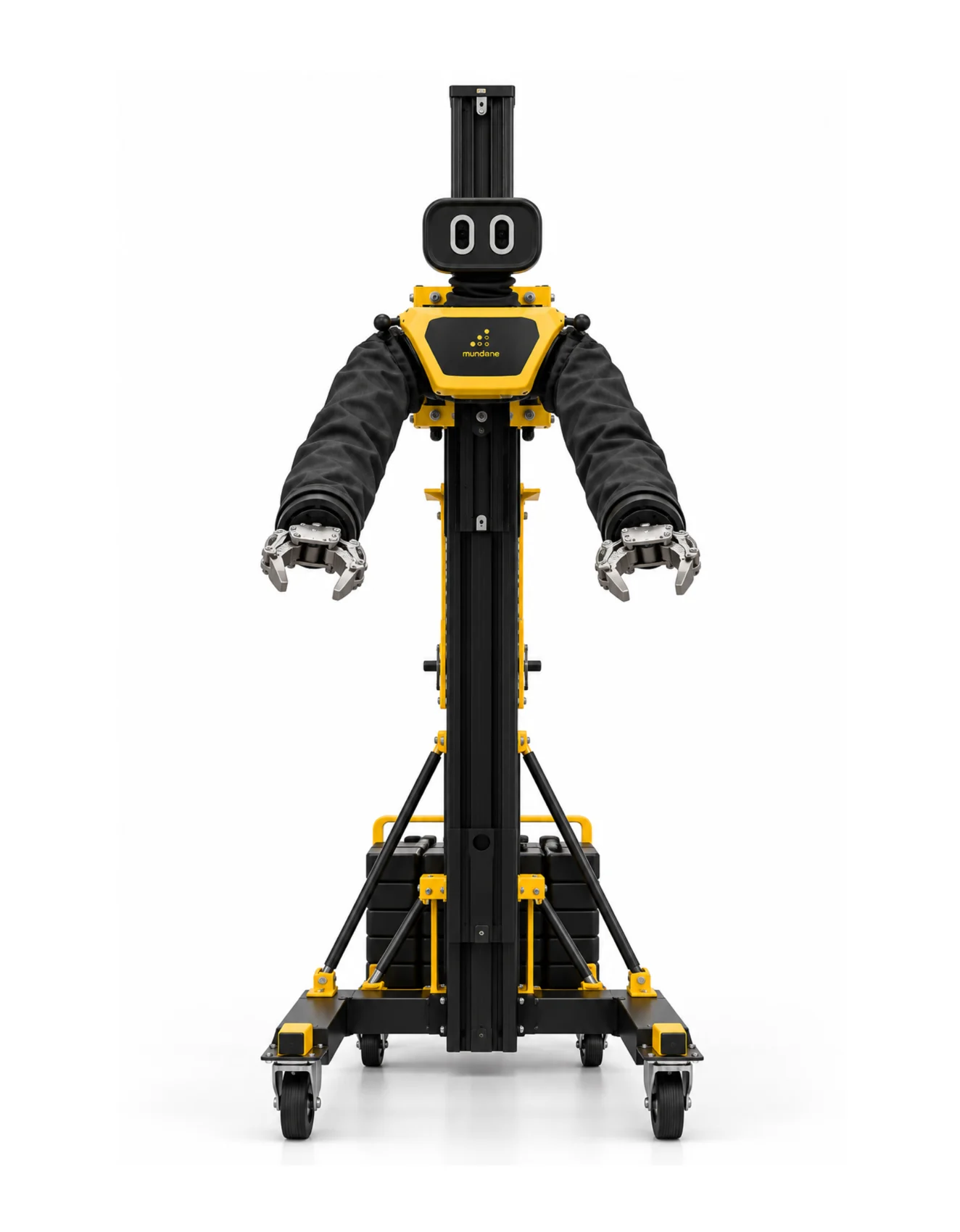
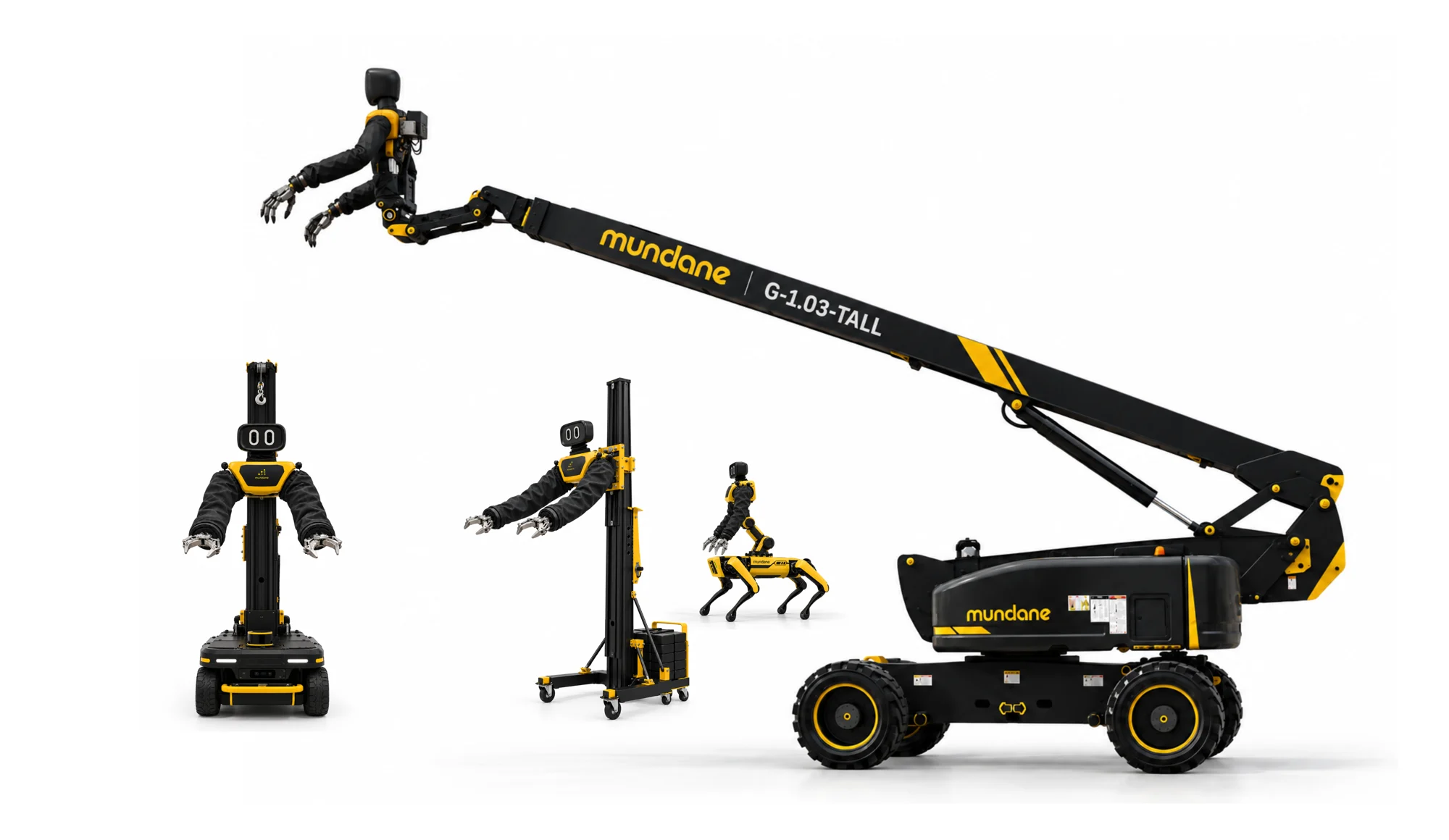
The part of a humanoid that does skilled work is the torso: two arms, two hands and a head with eyes. That is the part we build to match the operator joint for joint. Everything below it is a question of reach.
So we bring the torso, human or AI controlled, to exactly where it needs to be: on a wheeled base, on a mast, on legs or at the end of a boom. Each one gets it there in the most efficient, compliant way possible, on a system that can deploy today, not someday.
5The robot answers to you
Most of the conversation about robots and AI is about what machines will be able to do on their own. We are more interested in a different question: how do people stay in control of machines that are becoming very capable?
Our answer is physical. The robot moves because you move. It stops when you stop. You feel what it touches, so you know what it is doing to the world. You leave the controls by letting go. You never ask for a move the robot cannot make, and the robot never moves your own arm in a way you did not choose.
This is what we mean when we say the robot answers to you. It is an extension of a skilled person's hands, with that person's judgment in charge. When AI starts taking on parts of the work, it arrives the same way, inside an interface where the operator can feel it, check it and take over.
6From telepresence to autonomy
- The expert is the operator. We measure ourselves on how fast and how accurately people work through the robot. Setup takes minutes of fitting rather than weeks of learning a controller, so a master lineman or welder does not need to become a robotics specialist first.
- Remote work that pays. When people work through a robot at close to their normal speed, far more tasks become worth doing remotely. In hazardous trades, the operator also stays out of harm's way.
- Skill that transfers. Every job done this way records how a skilled person actually did it. That record can teach a robot the routine parts of a task, and operators correct it as it learns. This works for any skill, not just the trades.
- People direct it. As the robot takes on more, the operator's role shifts from doing every motion to directing and checking the work. The person stays in charge throughout.
Customers lease the robot and the exoskeleton, and their own qualified workers operate it under their own procedures. None of this depends on autonomy: the system is useful the day it arrives. Where customers allow it, the same work becomes the data that makes the robot more capable over time.
You start thinking about all the places we send guys into dangerous situations, and you realize there's a lot more work for something like this than just switching breakers.
Jake Holsthaus, lineman, 15 years on the tools, Written in Red Training
7Why it is hard to copy
We take remote operation seriously as a way to do real work. That makes integration the central problem: sight, touch and proprioception have to arrive together, faithfully and on time, so the worker feels present in the task and actually is. This is not immersion for entertainment. The test is whether it is useful on a real job.
Our advantage has two layers. The first is knowing how the three senses are designed together, across mechanics, controls and vision, learned over many iterations of the hardware. The second is harder to copy: a company that cares about what the operator feels. Another team could try to imitate the force feedback. But a team whose goal is to remove the human from the work will find it hard to care about that human's experience. We start from the worker, and we build for them.
There is a lot more to come.
Our long-term mission is indistinguishable telepresence: a remote robot that feels no different from being there. Along the way, we are training the future of autonomous trades work, with skilled people directing it.