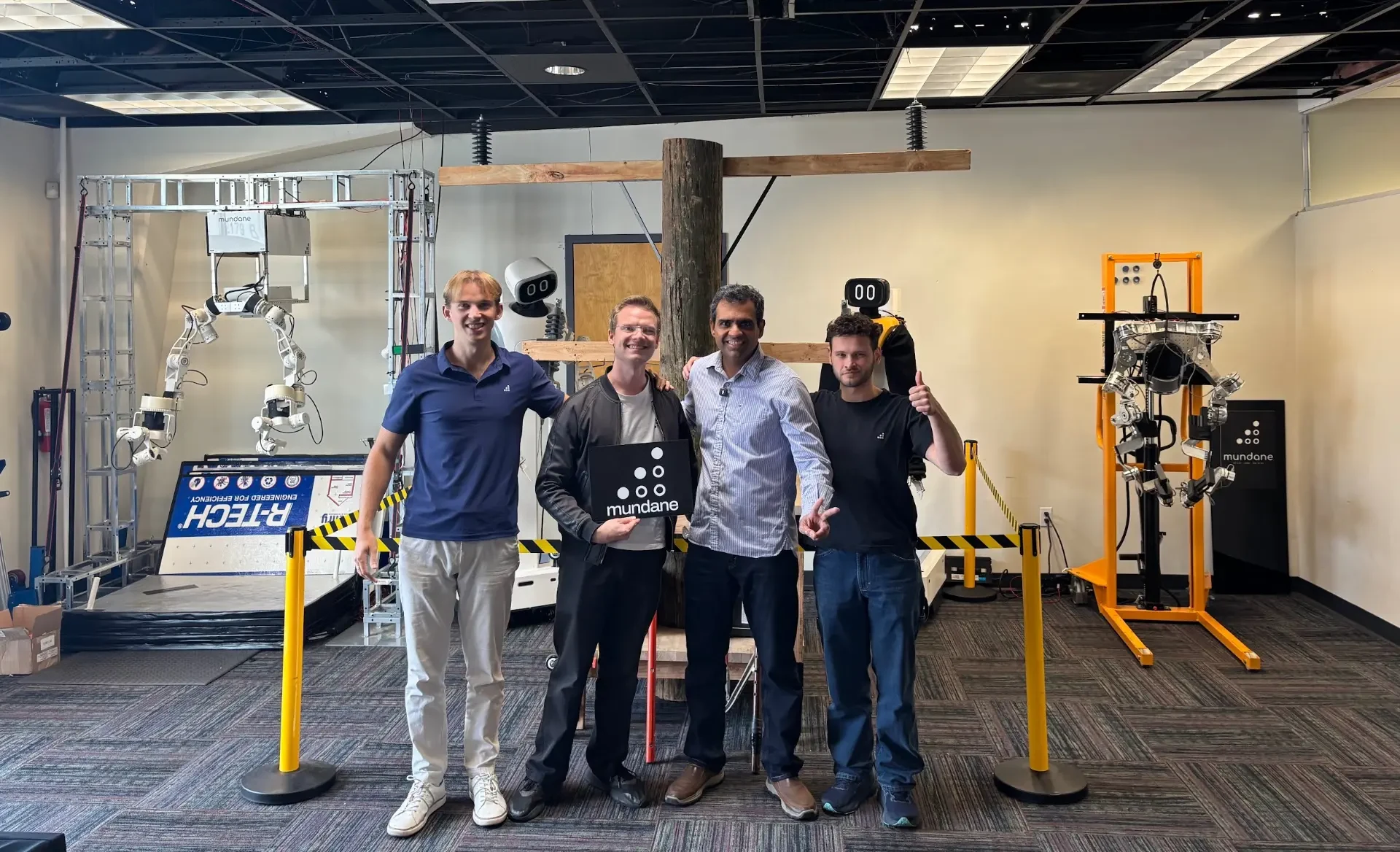
Devang Adhyaru, founder of The Humanoid Hub, spent an afternoon at the Mundane shop in Palo Alto. He drove the robots himself, met the team behind them, and recorded a tour and interview for his channel: Why Teleoperation Isn't Going Away.
Who Devang is
Devang started The Humanoid Hub on X because there were too few places to follow humanoid robotics in depth. It has since grown into one of the go-to communities for people tracking the field closely, covering new robots, research and the companies building them.
In October he took it offline. The Humanoid Hub Conference brought researchers and founders from 1X, Physical Intelligence, Skild AI, Dyna Robotics and others to San Francisco for two days of talks and live robot demos. Devang believes that seeing a robot in person, touching it and watching it move tells you something no video can. That's why he came to try ours.
The interface
COO Eoin O'Doherty, who joined as Mundane's first operator, set the scene. The robots are headed for the most dangerous trade environments: electrical work, other industrial settings and nuclear.
"Anywhere right now that a skilled human operator has to go and put themselves at risk, we want to send in a robot, but give the operator a really immersive remote control experience, so they can perform the same operation with absolute confidence, as if they were standing there themselves."
Eoin O'Doherty, COO
Because the system is useful before autonomy is mature, Eoin explained, customers buy it for a simple reason: to keep their workforce safe.
Cofounder Maximilian Drach runs projects from start to finish. His job is to make sure what the team builds can actually do the task the customer needs, in the environment they need it done. It also has to be simple enough for an operator who wasn't trained by Mundane, and covered properly for electrically charged work so there's no risk of arc flash.
Cofounder Cameron Hilman then walked Devang through our first-generation robot. His design goal was a one-size-fits-all system that captures the human skeleton through a world-grounded, seven-degree-of-freedom exoskeleton, rather than through visual motion capture or wireless controllers.
"Most people aren't thinking about how the humanoid robot is controlled. When it comes to actually controlling it, they just say, oh, that's going to be the AI."
Cameron Hilman, cofounder
The task was a fuse cutout, the switch linemen reset when a fuse blows on a distribution line. In the field it sits 30 feet up a pole with around 33,000 volts running through it. Linemen reset it from a bucket truck with a hot stick up to 10 feet long, often bracing themselves and looking away as they push it home. Mount the robot's arms, chest and head on the bucket instead, and it can get far closer than anyone should, while the lineman stays in control from a safe distance. If the worst happens, it's the robot that gets hurt.
Devang climbed in, closed the grippers, swept the fuse up and clicked it into the switch on his first attempt.
Force feedback
Dr. Felix Huang, our controls lead (the team also calls him the proprioception engineer), showed what changes when the operator can feel what the robot feels. In traditional robotics, the robot strictly follows whatever motion it's sent. That puts delicate work at risk, and the operator loses much of their sense of where they are in space.
Felix shook Devang's hand through the robot, then gave him two objects that looked identical. Devang could tell immediately that the second was harder. Then Felix handed him a bottle of chocolate milk to take home. Devang knew straight away it was empty.
The feedback isn't limited to the gripper. Wrist twist, flexion and elbow forces all come back through the exoskeleton, so the operator feels a table or a wall the moment the robot touches it.
"It's a negotiation between the leader and the follower, trying to figure out what motions are possible while still keeping low interaction forces."
Dr. Felix Huang, controls lead
Before Mundane, Felix lectured at Tufts University. Earlier still, he researched neurorehabilitation robotics, using robots to help stroke survivors relearn coordination. He brings the same priorities to teleoperation: the user's experience, motor neuroscience and biomechanics. On how he and Theo split the work:
"Theo's going to dream big, and I'm going to point to, well, maybe we can have a slightly novel take on actuators. And so we're going to push the frontier in reasonable increments."
Dr. Felix Huang
The interview
Devang then sat down with Theo for the interview, starting with what had struck him most on the visit:
"I could tell a difference between a bottle that's filled up and a bottle that's empty, even though I cannot see the liquid inside it."
Devang Adhyaru, The Humanoid Hub
His next question was the obvious one: if some at the frontier of robotics say teleoperation is on its way out, why build a company on it?
Theo gave two reasons. First, demonstrations on the robot itself are still the fastest way to teach a robot a task. Theo pointed to Tesla, where every driver taught the car to drive. Second, almost nothing deployed today is fully autonomous. Robots that work in the real world rely on a person who can step in when something goes wrong, and every correction makes the model better.
"Having a robot work once on a single task in a demo video is one thing. Having a robot trusted enough that we can leave it in the dark in a back room and not check on it for a few hours, that's a very big gap. We call that the deployment gap."
Theo Nash, cofounder and CEO
On force feedback, Theo described the full-joint system Devang had just tried. Actuators run the length of the exoskeleton, so when you grip a cup your hand stops in space and you feel the tea slosh. The arms are also designed with no singularities anywhere in the human workspace, so the robot can follow you wherever your arm goes.
On comfort, Theo compared the next step to noise-cancelling headphones. Instead of cancelling a steady hum, the system will cancel weight, so an operator can tell they're lifting something heavy without carrying all 40 pounds of it. In trades with high rates of carpal tunnel and repetitive strain injury, that matters as much as distance from the hazard.
On the trades, he pointed to the reception at NECA, where more than 100 tradespeople tried the system and Mundane won Best Booth.
"Our assumption is not that AI will learn how to do everything, but that we can build an amazing interface to help humans do what AI cannot."
Theo Nash
What's next
Theo sees today's exoskeleton as the Apple I of the category. Over the next decade it will shrink until it feels more like clothing, while the robot gets lighter, tougher and stronger. In the nearer term, the team wants to work with OSHA and contractors to make a robot the safety standard for the most dangerous work. They also want to show how much better an interface like ours is for robot learning than conventional leader-follower systems.
Thank you to Devang and The Humanoid Hub for the visit.
We're hiring across deployment, development, research and commercial. In Theo's words on the show: "We definitely like intense, very, very intense people. That, I would say, is our quality number one." See open roles